PRE ALGEBRA FRACTIONS

PRE Algebra Adding Subtracting Dividing Multiplying Fractions
Adding Fractions
Adding fractions is easy: just find the common denominator and then add the fractions.
Also, once the fraction is solved, you can simplify the fraction.
Example: 1/5 + 1/9 =The lowest common denominator is 45
5 x 9 equals 45, so 1/5 becomes 9/45
9 x 5 equals 45, so 1/9 becomes 5/45
9/45 + 5/45 = 14/45
Now simplify this by finding a number that divides equally into both numerator and denominator
This cannot be simplified so the answer is 14/45
Practice Adding Fractions:
Reduce or simplify when possible2/10 + 4/4 =
2/10 - to get 20 for the denominator we multiply x 2, and then we multiply this also x the numerator
4/10 +
4/4 - to get 20 for the denominator we multiply x 5, and then we multiply this also x the numerator
4/20 + 20/20 = 24/20, Now we simplify if possible
12/10 as 2 goes into both 24 and 20
6/5 as 2 goes into both 12 and 10
And, reduce or simplify 6/5 also
Answer is 1 1/5
PRACTICE:
1/6 + 5/8 =
24 is the lowest common denominator
4/24 + 15/24 =
Answer is 19/24
3/4 + 1/12 =
12 is the lowest common denominator
9/12 + 1/12 =
10/12
Answer is 5/6
Subtracting Fractions
When subtracting fractions, follow the same rules as for adding fractions. Find the lowest common denominator, the solve the problem.
Example: 1/3 - 1/6 =The lowest common denominator is 6
1/6 remains as 1/6 as it is the lowest common denominator
1/3 - 3 must be multiplied x 2 to get 6, so the numerator is multiplied by 2 also
2/6 - 1/6 = 1/6
This cannot be simplified so the Answer is 1/6
Practice:
1/5 - 2/15 =
The lowest common denominator is 15
1/5 becomes 3/15, multiply the denominator and numerator by the same number, 3
3/15 - 2/15 = 1/15
This cannot be simplified so the Answer is 1/15
3/7 - 1/49 =
The lowest common denominator is 49
21/49 - multiply the denominator and numerator by the same number, 7
21/49 - 1/49 = 20/49
This cannot be simplified so the Answer is 20/49
Dividing Fractions
The rule for dividing fractions is:
Invert the fraction after the divide sign and then multiply, simplify if possible.
Example:1/3 ÷ 1/4 = Invert the fraction after the divide sign, then
1/3 x 4/1 = Multiply the fraction
equals 4/3 Simplify the fraction if possible
4/3 = 1 1/3 Answer
Multiplying Fractions
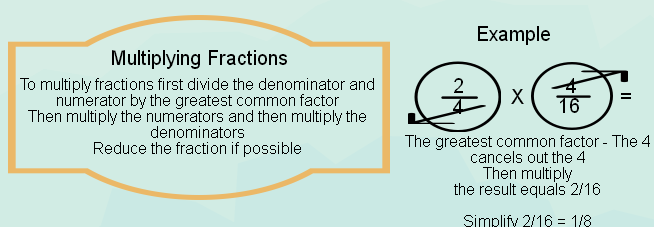
PRACTICE:
12/16 x 1/4 =
greatest common factor is 4, 4 into 4 of 1/4, and 4 into 12 of 12/16,
3/16 x 1/1 = 3/16
Answer is 3/16
2/3 x 6/10 =
greatest common factor is 2 and 3, 2 into 2 of 2/3 and 10 of 6/10, and
3 into 3 of 2/3, and 6 of 6/10,
equals 2/5 Answer
FYI:
When multiplying: you can reduce the fractions by finding greatest common factors that will divide into each fractions denominator numerator,then multiply, or you can just multiply and then simplify to get the answer.
Example2/6 x 4/12 = multiply numerators = 2 x 4 = 8
multiply denominators = 6 x 12 = 72 for 8/72 Simplify 1/9
or divide greatest common factors into the fractions to reduce them before multiplying
2/6 equals 1/3, and 4/12 equals 1/3,
1/3 x 1/3 equals 1/9
NEXT - Pre Algebra - Decimals
PREVIOUS - Pre Algebra - Types of FractionsALGEBRA - BECAUSE IT'S FUN TO LEARN